Deadly Graffiti Typography for Machine Embroidery
First Impression of Deadly Lettering Art
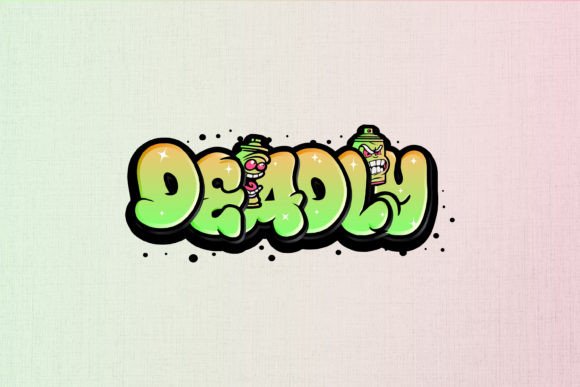
When I opened the Deadly design file, the first thing that struck me was the raw street energy packed into every letterform. This is not a clean, polished script or a delicate serif. This is graffiti lettering typography that leans hard into an urban, edgy, almost rebellious mood. The shapes feel jagged, spontaneous, and deliberately imperfect in a way that makes the whole composition feel alive. As someone who has tested hundreds of machine embroidery design files on actual fabric, I immediately started imagining how these thick strokes, aggressive angles, and bold negative spaces would translate into thread on a sweatshirt or a canvas tote.
The illustration carries a visual weight that demands attention. It does not whisper. For a designer preparing a custom apparel piece, that personality matters. A design like Deadly will not blend into the background. It wants to be the focal point, and honestly, that is exactly what many Etsy seller listings and boutique products need right now. The urban typography trend has legs, and this piece captures it without feeling like a cheap clip-art knockoff.
Where Deadly Truly Belongs in an Embroidery Project
I could picture this immediately on a heavyweight cotton sweatshirt, the kind with a relaxed fit and a slightly structured hood. Deadly graffiti lettering would sit across the chest or the back with a presence that makes the garment feel intentional, curated, and street-smart. This is not your average floral monogram. It speaks a different language entirely, one that resonates with younger buyers, streetwear enthusiasts, and anyone building a brand around bold self-expression.
Beyond sweatshirt embroidery, I thought about tote bag design possibilities. A black canvas tote with Deadly stitched in a contrasting thread color like neon orange, acid green, or even a matte charcoal on black would create a subtle but powerful statement piece. For craft fair tables and small shop product displays, that kind of item stops people mid-stride. It feels current. It feels like something they would not find in a big-box store.
Other natural homes for this design include:
- Embroidered patch applications on denim jackets, backpacks, or caps
- Personalized throw pillow covers for a teen bedroom or streetwear-inspired home decor
- Aprons for baristas, tattoo artists, or anyone whose workspace thrives on creative grit
- Boutique branding merch for music producers, graphic artists, or urban lifestyle brands
The design also lends itself surprisingly well to holiday embroidery projects if your audience leans toward non-traditional gifting. Imagine a crisp hoodie under the tree for a nephew who lives in graphic tees, or a birthday patch sewn onto a jacket for someone who collects statement pieces. The versatility comes from the attitude, not the occasion.
Real Stitch Reality and Fabric Considerations
Here is where my practical brain kicked in. A graffiti lettering design like Deadly is not a simple three-inch monogram. The typography art illustration contains layered shapes, sharp internal angles, and fluid outer contours that will require careful digitizing and thoughtful fabric choices. If you are planning to run this as a machine embroidery design, you must respect the complexity.
On stable, medium-to-heavyweight fabrics like canvas, twill, denim, or structured cotton, Deadly will stitch out with crisp edges and a satisfyingly dense presence. I would lean toward a satin stitch for the main letter bodies, possibly with a light fill stitch for larger internal areas if the design is scaled up beyond five or six inches wide. The key is maintaining that graffiti flow without letting the thread work become so heavy that the fabric puckers or the design loses its sharpness.
Where should you use caution? Any thin fabric, stretchy fabric, or loosely woven textile could turn this bold artwork into a wavy, distorted mess. I would avoid ultra-light t-shirts, ribbed knits, and anything with significant mechanical give unless you are highly confident in your stabilizer choice and hooping technique. Even then, the stitch density required to faithfully reproduce the Deadly lettering shapes might overwhelm delicate fibers.
Dark fabrics present another interesting challenge. If the design uses dark thread colors, contrast can disappear on black or navy backgrounds. I always recommend testing the design file on both light and dark fabric swatches before committing to a production run. What looks electric on a screen mockup may feel muddy once stitched, and with a piece this bold, you cannot afford to lose that visual snap.
For curved surfaces like caps, the Deadly design will need careful placement and likely some scaling down. The aggressive lettering angles could fight against the cap's curvature, so I would test on a structured six-panel cap rather than an unstructured dad hat. A hoop size check is non-negotiable here. If the design is too wide for your cap hoop, you are either resizing, splitting, or choosing a different product.
Thread Color Choices That Make Deadly Sing
Graffiti art lives and breathes through color. With Deadly, you have room to play. I would explore high-contrast combinations that mimic spray paint culture: neon pink on black, electric blue on white, acid yellow on charcoal, or even a multi-color thread approach if your machine supports it and your patience allows. The design file includes a PNG transparent file at 300dpi, which makes creating printable mockup previews for your shop listings a breeze. Use that to test color combinations visually before you ever thread a needle.
For sellers building Etsy seller mockups or digital product previews, having the AI, EPS, SVG, and PNG files in one pack gives you serious flexibility. You can place the Deadly artwork onto product photos, tweak colors in vector software, and present variations to customers without stitching a single sample. Just remember that a mockup is not a stitch-out. Real thread behaves differently than pixels, especially in tight corners and small interior spaces.
Small Details That Deserve Extra Attention
In my review process, I zero in on the tiny stuff that can derail an otherwise great project. With Deadly, watch the internal negative spaces within the letters. Those gaps that read perfectly at screen resolution can close up under thread if the stitch density is not dialed in. A running stitch detail might need to be adjusted to an outline-only approach in very small scales. This is not a design I would recommend shrinking below three inches wide without serious testing and likely some manual simplification.
I also advise running a black-and-white printout of the design before digitizing. Take away the color distraction and look purely at the shape relationships. If the lettering still reads clearly in monochrome, you have a strong foundation for an embroidery file that will hold up across products. Deadly passes that test reasonably well, but the most intricate areas near the letter connections should be inspected closely.
Before listing finished products, run through this checklist:
- Stitch a test sample on the exact fabric type and color you plan to sell
- Wash it once or twice to see how the threads settle and whether any distortion appears
- Check for thread breaks in dense areas, especially sharp corners and overlapping strokes
- Confirm your hoop size comfortably accommodates the design at your chosen scale
- Review the thread colors under natural light, not just under your sewing lamp
Commercial Use, Branding, and Customer Perception
From a business standpoint, Deadly fills a specific niche that many craft business owners are chasing right now. The urban, graffiti-inspired aesthetic is underrepresented in handmade marketplaces dominated by florals, script fonts, and cutesy motifs. Offering a product with this artwork says something about your brand. It says you understand edge, culture, and the kind of customer who wants their personalized gift to feel more street than sweet.
For commercial embroidery projects, I could see Deadly working on limited-run merchandise, music artist pop-up shop items, skate shop collaborations, or even as part of a branded uniform for a creative agency. The graphic nature of the lettering means it reproduces clearly in photographs, which matters enormously for social media marketing and online storefronts. A crisp embroidered patch with Deadly on a beanie or a backpack photographs beautifully and grabs attention in a crowded feed.
Customer trust is built on quality execution. When someone buys a sweatshirt with Deadly stitched across the chest, they are not just buying thread on fabric. They are buying the attitude the design projects. If your stitch work is sloppy, if the lettering loses its graffiti bite because you cheaped out on stabilizer or rushed the digitizing, the product fails emotionally. Take the time to get it right, and Deadly will reward you with a finished product that customers feel proud to wear and share.
Practical Designer Notes for Real Projects
Let me share a scenario. I recently prepared a custom tote bag order for a client who runs a small barbershop with a street-culture vibe. They wanted something that felt like an art piece, not a logo. I pulled up the Deadly design files, experimented with thread colors that matched their shop interior, and stitched a sample on a heavyweight natural canvas tote. The result stopped conversations. People asked where they could get one. That is the power of choosing a design asset with genuine personality rather than a forgettable generic option.
If you are planning to use Deadly for baby embroidery or nursery decor, I would pause and think carefully about context. A graffiti lettering style might feel out of place on a delicate baby blanket or a pastel onesie, but it could absolutely work for a modern urban nursery with a street-art mural wall or a photographer's newborn announcement piece styled with edgy, contemporary props. Know your audience.
For holiday embroidery, do not be afraid to lean into the unexpected. A graffiti-style "Deadly" slogan on a red hoodie for a teenager, or a graphic patch sewn onto a stocking for a family member who collects streetwear, creates memorable gifts that stand apart from the usual snowflakes and reindeer.
One final reminder. Since the product description does not specify exact stitch counts, machine formats beyond the provided AI, EPS, SVG, and PNG files, or commercial embroidery licensing details, I strongly encourage you to confirm these points with the seller before selling finished items. The listing clearly states this is a digital file pack and not a physical product. It is your responsibility as a maker or shop owner to understand how the files can be used legally and to digitize them appropriately for your specific embroidery machine. Protect your business by checking license terms, especially if you plan to sell finished products, include the design in a brand collection, or offer it as part of a digital embroidery file bundle you resell.
Overall, Deadly earns its name through visual impact, not difficulty. Treat it with the respect any strong typography design deserves, test thoroughly, and you will have a handmade product that cuts through the noise with authentic street energy and professional polish.